.png)
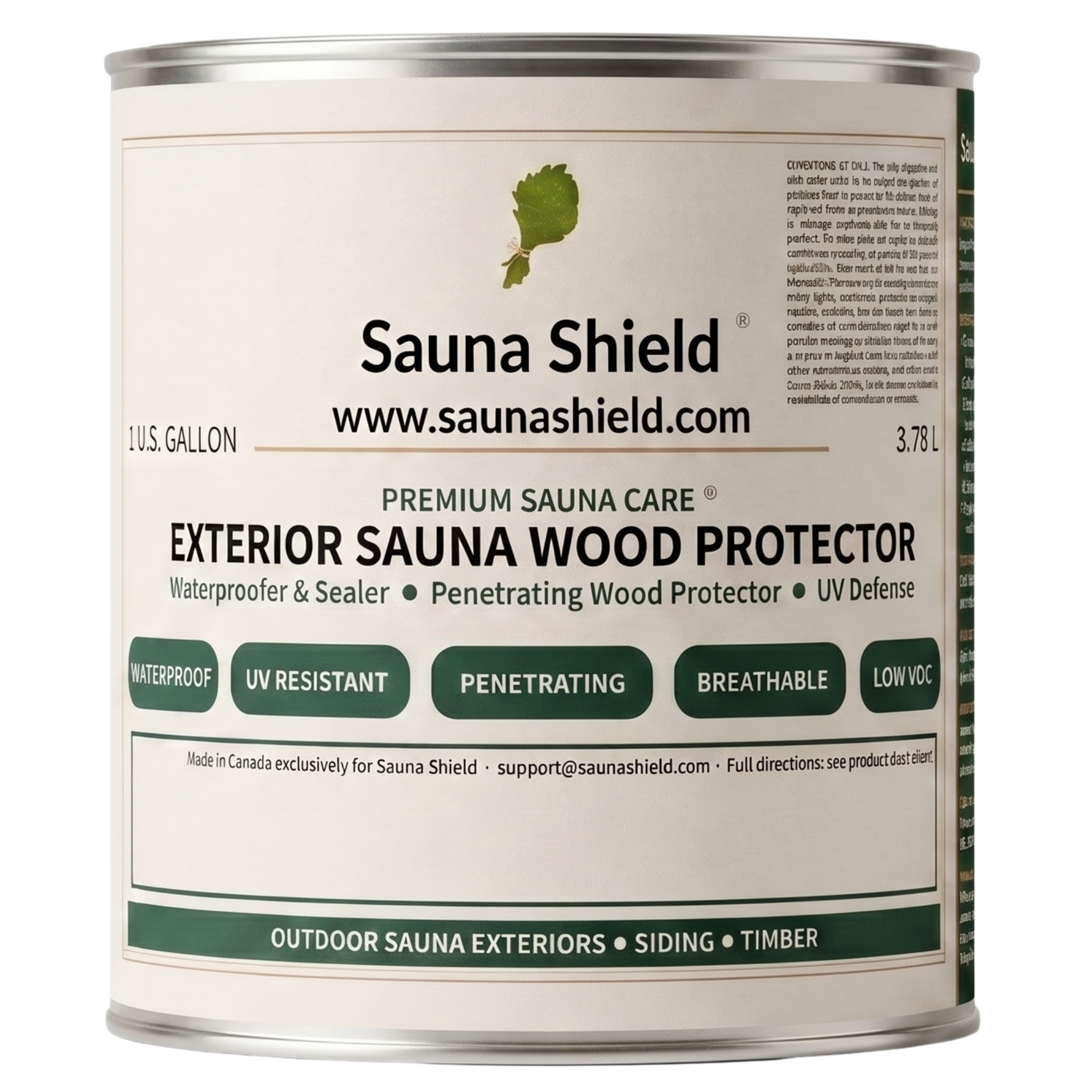

A waterborne, penetrating sealer built for outdoor saunas, cedar siding, fences, and timber. It soaks into the wood and bonds inside the fiber instead of forming a film — so it cannot crack, peel, flake, or blister. Water beads and runs off, vapor still escapes, and maintenance is a wash and one fresh coat instead of a scrape-and-sand weekend.
Exterior surfaces only. Not for use inside the hot room — no benches, backrests, headrests, walls, or ceilings.
1 US gallon (3.78 L) · Two coats required · Water cleanup · Non-flammable
Sauna Shield Wood Sealer & Stain for Outdoor Saunas | 1 Gal
Your sauna is outside in the weather 365 days a year
Rain, snowmelt, freeze-thaw cycles, and UV do not take the winter off. Untreated cedar answers with gray blotching, black water staining, raised grain, checking, and eventually rot at the end grain and stave joints.
Sauna Shield is built for exactly that job. It is a waterborne, penetrating wood treatment — not a coating that sits on top. It soaks into the fiber and bonds there. Water beads and runs off. Water vapor still escapes. Because there is no film, there is nothing to crack, peel, flake, or blister.
Penetrating vs. film-forming — why it matters
Sauna Shield (penetrating)
Varnish, poly, solid stain (film-forming)
How it works
Bonds inside the wood fiber
Sits on the surface as a film
Failure mode
Erodes slowly and evenly
Cracks, peels, flakes, blisters
Trapped moisture
Breathes — vapor escapes
Seals moisture in behind the film
Recoat prep
Wash, dry, one coat
Strip or sand back to bare wood
Maintenance
A weekend chore
A weekend project
Water and moisture uptake — sheds liquid water, reduces the absorption that drives movement and decay
Blackening and wood rot — contains a film preservative that resists the surface growth that darkens exterior wood
Warping, shrinking, cupping, and checking — dimensional stabilization limits the swelland-shrink cycle that opens joints and splits barrel staves (tinted colors)
UV graying and fading — finely ground iron oxide pigments screen ultraviolet light (tinted colors only — see the color notes below)
This is not a suggestion, and it is not optional on the lighter colors. Natural and translucent tones carry less pigment, and pigment is what delivers both color longevity and UV protection. One coat will look right the day you apply it and fade early. The second coat is what buys you the service life.
Outdoor sauna exteriors — barrel saunas, cabin and cube saunas, sauna doors, exterior trim and surrounds, cold plunge cabinets
Wood siding and cladding, board-and-batten, shiplap, rainscreen, trim
Log homes, timber frame, post and beam, exposed structural timbers
Fences, gates, gazebos, pergolas, arbors, screens, planters, garden structures
Cedar shakes, shingles, and wood roofing
Outdoor furniture and hot tub skirting
Accoya, thermally modified wood, shou sugi ban and charred wood
New, weathered, or freshly restored bare wood
Sauna interiors. Do not apply to benches, backrests, headrests, walls, or ceilings inside a hot room, or to any surface that contacts bare skin at sauna temperatures.
Interior floors, countertops, cutting boards, or any surface in contact with food
Surfaces already coated with paint, solid stain, varnish, or sealer — penetrating products need open, bare wood
Non-wood substrates: metal, masonry, concrete, composite decking, plastic
Pressure-treated wood that is still wet from treatment — let it dry thoroughly first
Final color depends on the wood as much as on the product. Species, age, grain, texture, and porosity all change how the pigment reads — the same color looks different on cedar than on spruce, and different again on thermally modified wood. End grain and softer earlywood absorb more and appear darker. The second coat deepens the color noticeably, so judge the result only after both coats have dried.
Always test an inconspicuous area first, let it dry fully, and confirm the appearance before coating the whole project.
Five tinted colors plus Clear. The tints form an opacity ladder — opacity determines how much grain stays visible and how much UV protection the pigment delivers.
Color
Opacity
Grain
Character
Clear
No pigment
Fully visible
Dries clear. Wood weathers to an even, natural silver-gray patina. No UV screening.
Sahara Mist
Natural — lowest pigment in the tinted range
Fully visible
Pale, warm, neutral sand tone. Changes the look of the wood least while still adding protection
Light Honey
Natural — lowest pigment in the tinted range
Fully visible
Golden amber. Warms and brightens pale species — spruce, pine, hemlock
Natural Cedar
Natural — lowest pigment in the tinted range
Fully visible
Warm cedar tone. Enriches cedar and lends a cedar cast to species that lack it.
Espresso
Natural — lowest pigment in the tinted range
Visible through the tone
Deep, warm coffee brown. Reads as dark stained wood, not brown paint.
Black
Solid hide — opaque
Texture shows, grain hidden
Opaque black. Highest pigment load, so the highest UV and fade resistance in the range. Covers weathered, patched, or mismatched wood.
Choosing between the three light options: Sahara Mist is the most subtle, Light Honey is the golden one, Natural Cedar is the warm reddish-brown one.
Considering Clear? Read this first. Clear keeps the natural look but has no pigment, and pigment is the mechanism that screens UV. That means Clear gives the least UV defense and the shortest maintenance interval in the line — 2 to 4 years on vertical surfaces versus 3 to 6 for the tints. If your goal is "protect it but don't change how it looks," Sahara Mist is usually the better answer: barely any visible color change, meaningfully better protection.
Sauna Shield Clear goes on milky white and dries clear, leaving no pigment behind. It lets your wood do what wood outdoors naturally does — settle into a soft, even silvergray patina — while the treatment keeps water, blackening, and rot out underneath. The difference is that it silvers uniformly and cleanly instead of blotching and streaking. Clear has no pigment, and pigment is what screens UV. Clear will not hold the original wood color and does not slow the graying. If you want to keep a warm tone and add UV protection, choose Natural Cedar, Light Honey, Sahara Mist, Espresso, or Black.
Spec
Value
Coverage
200–350 sq ft per gallon, per coat
Two-coat project
~115–200 sq ft of finished surface per gallon
Coats required
2
Wet film
6–8 mil first coat, 4–6 mil second
Appearance when dry
Clear, natural matte, no added gloss
Base
Waterborne
VOC
Less than 5 g/L
Dry to touch
~2 hours at 68 °F / 50% RH
Recoat
~2 hours
Before handling or stacking
Up to 24 hours
Prep sanding
80–100 grit (do not go finer)
Maintenance interval
Every 2–4 years, exposed vertical surfaces
Cleanup
Warm water and soap
Flammability
Non-flammable
Shelf life
18 months unopened
Origin
Canada
Coverage-by-surface note: planed or sanded smooth wood runs 300–350 sq ft/gal; rough-sawn or textured wood 250–300; weathered, dry, or highly porous wood 200–250.
All five share one base formula and one set of technical properties. They differ in pigment type and loading, which determines opacity.
Spec
Value
Size
1 US gallon (3.78 L)
Coverage
~265 sq ft per gallon at 6 mil wet, subject to penetration
Two-coat project
~130 sq ft of finished surface per gallon, average
Coats required
2
Wet film
6 mil (150 micron) per coat
Finish
Low lustre, near-matte — no plastic sheen
Base
Waterborne, finely ground iron oxide pigments
VOC
32 g/L actual; 152 g/L regulatory
Dry to touch
Under 2 hours at 68 °F
Recoat
2+ hours
Full cure
3–4 days
Rain resistance
Keep off the coating for 24 hours after application
Prep sanding
60–80 grit
Maintenance interval
Every 3–6 years, vertical surfaces (sooner on decks and horizontals)
Cleanup
Soap and warm water
Flammability
Non-flammable
Shelf life
18 months unopened
Origin
Canada
Cure note: do not stack, cover, or place furniture or cushions on coated surfaces during the 3–4 day cure, and avoid heavy use. Drying and curing take longer in high humidity or at low temperature — plan around the weather, not the clock.
Decks: decks are within the intended use for the tinted colors. Horizontal surfaces hold standing water and take traffic and abrasion, so expect a shorter maintenance interval on decks, stairs, and railings than on vertical cladding, and inspect them annually.
Ambering: a slight darkening can occur on surfaces kept in the absence of light — under deep eaves, or components stored in the dark. It reverses on exposure to normal daylight and is not a defect.
NATURAL CEDAR
New cedar looks incredible for about one season. Then UV lightens the warm reddishbrown, flattens it to silver-gray, and turns it chalky — and once water soaks into that opened-up surface you get black staining, raised grain, and splitting at the joints. Natural Cedar is a translucent warm cedar tone that adds color rather than covering. Grain, knots, and character read through clearly. On fresh cedar it deepens and enriches what is already there. On spruce, hemlock, or pine it lends the warm cedar cast those species do not have on their own. Best on western red cedar and redwood, and the right pick if you want cedar to keep looking like cedar.
LIGHT HONEY
Spruce and hemlock saunas have a problem cedar does not: they start out pale and a little flat, and they go gray fast. Light Honey fixes both halves at once — it adds the warm golden tone the wood never had, and it keeps water out. Light Honey is a translucent golden amber. It reads warm and bright, closer to honey or clear pine than to red cedar. On pale species — spruce, pine, hemlock, poplar, light cedar — it delivers real warmth and richness. On darker cedar and redwood it warms and brightens the existing tone. Choosing between this and Natural Cedar? Light Honey is the golden, brighter option and the better pick for spruce, pine, and hemlock. Natural Cedar is the warmer reddish-brown one.
SAHARA MIST
Most sauna owners want two things and assume they cannot have both: keep the wood looking like new wood, and stop it from going gray. Clear delivers the first and gives up ground on the second. Sahara Mist is the answer to that trade-off — enough pigment to fight UV, not enough to change the look of your sauna. Sahara Mist is a light, warm, neutral sand tone. No red, no gold — it reads soft and hazy, like clean dry wood in flat light. Because it carries so little pigment and is fully translucent, it adds tone rather than color. On new cedar it holds that fresh-milled look. On spruce, hemlock, and thermally modified wood it evens out blotchiness and takes the rawness off without warming the wood the way Light Honey does. This is the lightest tint in the line, so it carries the least pigment per coat. Two coats is a requirement here, not a suggestion. The effect is subtle by design — this is a tinted product, and on porous wood you will see a visible sand tone. Test an area first.
ESPRESSO
Espresso is a deep, warm coffee brown — the dark option that still shows the wood. It reads as dark stained wood, not brown paint. Grain and texture come through the tone rather than disappearing under it. The heavier pigment load means stronger UV and fade resistance than the lighter tints, and it evens out wood that has already started to weather unevenly.
BLACK
Black is the only opaque color in the line — solid hide. Texture and mill marks still show, but the grain is covered. It carries the highest pigment load in the range, which makes it the most UV- and fade-resistant color Sauna Shield offers, and it is the one option that will cover weathered, patched, or mismatched wood and give a barrel or cube sauna a single uniform look.
Color accuracy
Screens are not wood. Color varies with species, age, grain, texture, and porosity, and the effect on your wood will differ from the photos. Always test an inconspicuous area, let it dry fully, and confirm the appearance before coating the full project. We cannot warrant color match.
Cold-weather shipping (run Nov–Mar)
This product is permanently damaged by freezing. Between November and March we hold or reroute orders to northern destinations when transit temperatures are forecast below freezing. If your delivery is delayed in winter, that is why.
Buy for the whole project at once
Order enough for the entire project in one purchase so all of it comes from the same production batch. On pigmented colors, a batch difference can show as a visible color shift across a wall.
Documents
Product Data Sheet and Safety Data Sheet available for download on this page. Read both before use.
Limited warranty
Sauna Shield warrants only that this product is free from manufacturing defects at the time of sale. The sole remedy is replacement of the quantity shown to be defective; proof of purchase required. Labor and reapplication costs are excluded. No warranty is made as to color match, color retention, or service life. The user is responsible for determining suitability before application. Full terms in the Product Data Sheet.